How to read a crochet chart: symbols, rows and rounds
Crochet charts are a picture of the stitches. Learn ten symbols and two reading directions and you can follow patterns in any language.
By YarnHook
|3 min read
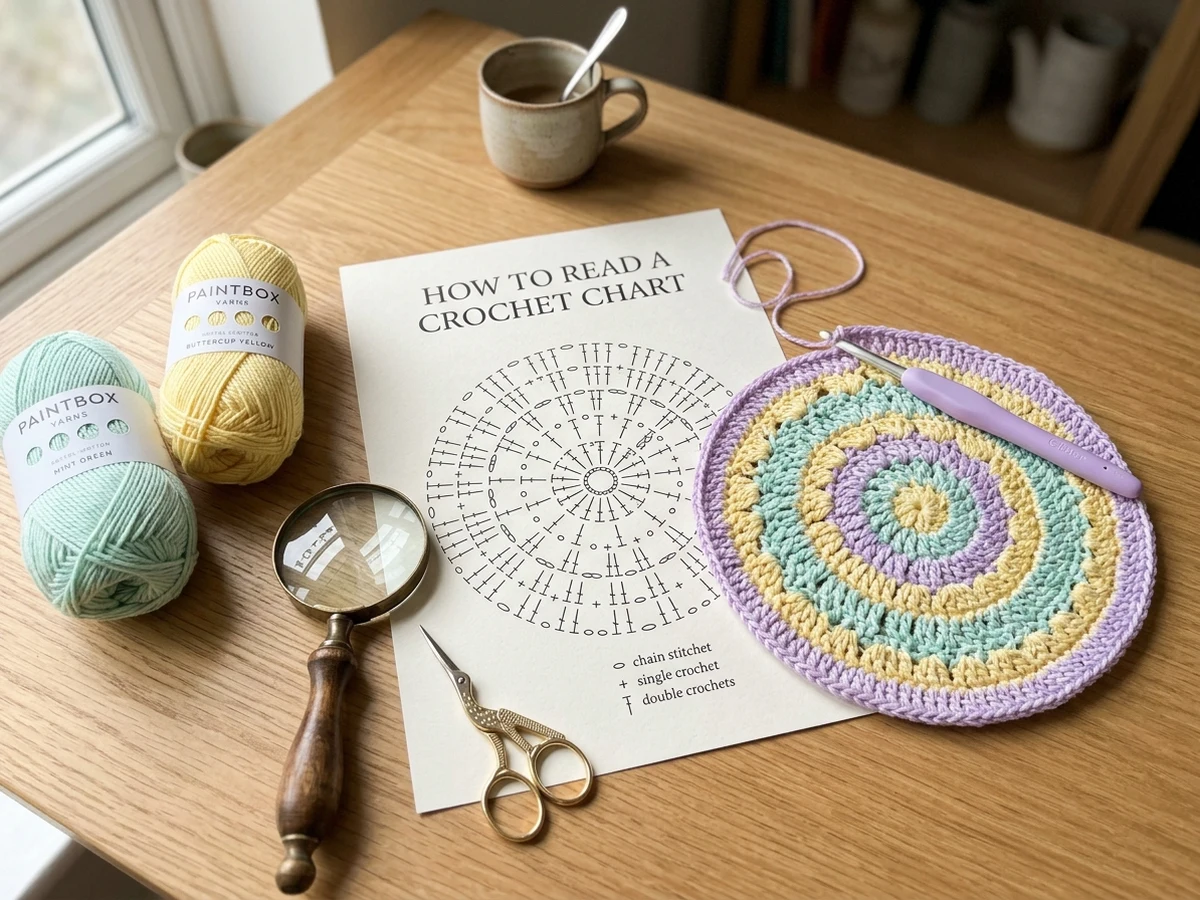
A crochet chart is a drawing of the finished stitches. Each symbol is one stitch, and its shape tells you roughly how tall it is. Once you know a handful of symbols, a chart is often faster to follow than written instructions, and it works in any language.
The basic symbols
| Symbol | Stitch | Abbreviation | How to recognise it |
|---|---|---|---|
| Oval | Chain | ch | A small loop |
| Filled dot | Slip stitch | sl st | The smallest mark |
| + or × | Single crochet | sc | Short, no stem |
| T | Half double crochet | hdc | A stem with a bar on top |
| T with one slash | Double crochet | dc | Taller stem, one diagonal line |
| T with two slashes | Treble crochet | tr | Taller still, two lines |
| Arc under a symbol | Back or front loop | BLO / FLO | Shows which loop to use |
The diagonal lines across a stem show how many times you yarn over before inserting the hook: one for double crochet, two for treble.
Combined symbols
- Increase: two symbols that share a base, like a V. Work both into the same stitch.
- Decrease: two symbols that join at the top, like an upside-down V. Work them together.
- Cluster: several symbols that start in one place and join at the top.
- Shell: several symbols fanning out from the same base.
Reading rows
Charts in rows start at the bottom. The foundation chain is drawn along the bottom edge, and the row numbers sit at the end where each row starts.
- Odd rows (1, 3, 5...) are read from right to left.
- Even rows (2, 4, 6...) are read from left to right, because you've turned your work.
The turning chain is drawn at the start of each row, standing upright.
Reading rounds
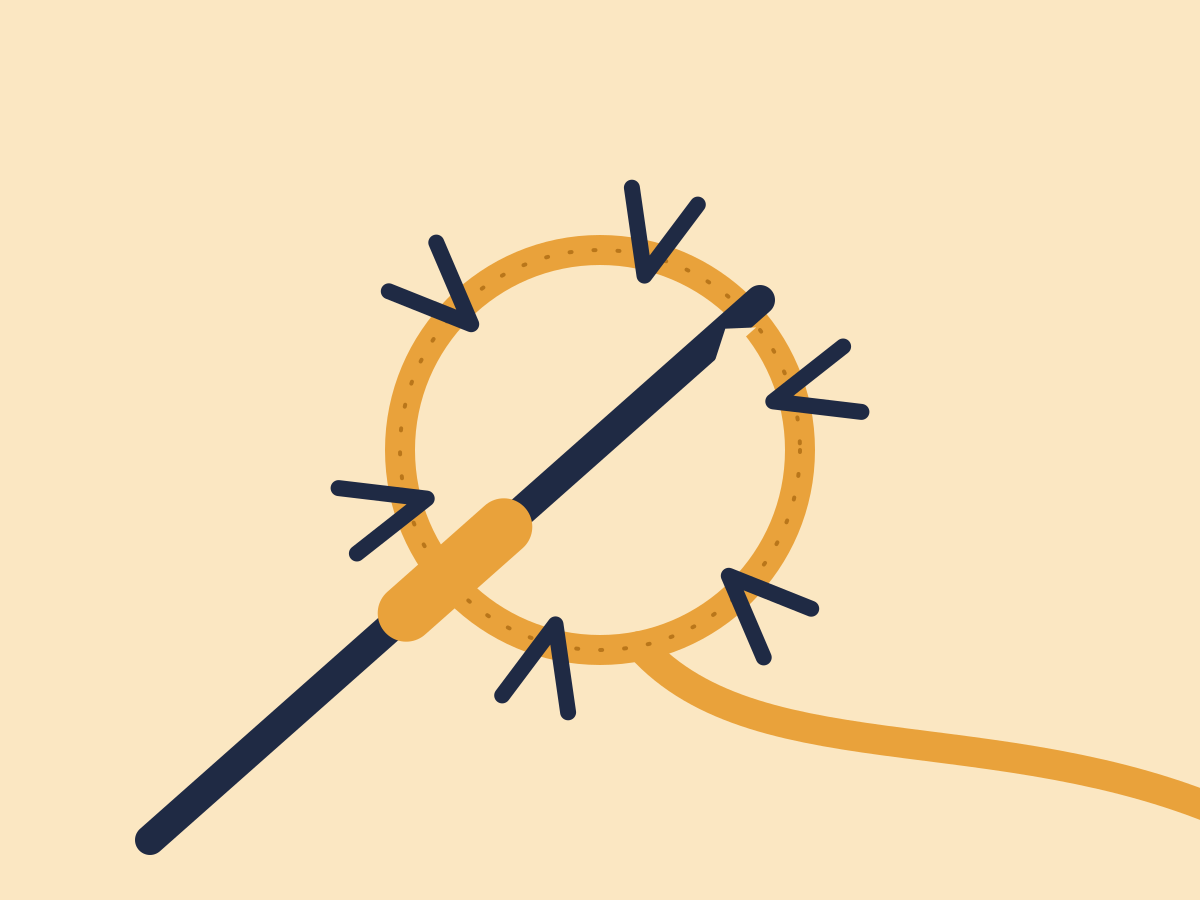
Charts in the round start at the centre, usually with a ring or a magic ring drawn in the middle.
- Read each round counterclockwise (for right-handed crocheters).
- The round number sits next to the round's first stitch.
- Colours or alternating black and grey lines help you tell rounds apart.
Try it: a granny square, round 1
Here's round 1 of a classic granny square, as you'd see it on a chart:
- In the centre: a ring of chain ovals.
- Standing on the ring: a stack of 3 chain ovals. That's the ch 3 that counts as the first dc.
- Next to it: 2 double crochet symbols (T with one slash), all sharing the ring as their base.
- Then 2 ovals (ch 2), then 3 more dc symbols, and so on around.
- A filled dot at the top of the first ch 3: the slip stitch that joins the round.
Written out, that's: "Ch 3, 2 dc in ring, ch 2, (3 dc in ring, ch 2) 3 times, sl st to top of ch 3." The chart shows the same thing, plus where each stitch sits.
When to use charts or text
Charts are great for lace, motifs and anything with a repeating shape. Written instructions are better for stitch counts and sizing. Most good patterns give you both: use the chart to see the shape, and the text to check your counts.
Questions about this pattern
Are crochet chart symbols the same everywhere?
Mostly. The core symbols for chain, slip stitch, single, half double and double crochet are an international standard, which is why charts work across languages. Some designers add their own symbols for special stitches and explain them in a key.
Do left-handed crocheters read charts differently?
Yes. Left-handed crocheters read rows left to right on odd rows, and rounds clockwise. You can also flip the chart image horizontally to make it match.
YarnHook
Free crochet patterns and tutorials
YarnHook publishes free crochet patterns and tutorials in plain language, using US crochet terms.